CARDIFF UK
CARDIFF
HomeImprovementGeotechnical Drainage Design

Geotechnical Drainage Design in Cardiff

Evidence-based design. Reliable delivery.

LEARN MORE

Cardiff's geology is shaped by glacial till overlying Mercia Mudstone and the Wentloog Formation, creating variable groundwater conditions across the city. In areas like the Cardiff Bay basin, the water table sits less than 2 metres below ground, while the elevated northern suburbs see deeper levels and perched aquifers. Effective geotechnical drainage design must account for these contrasts: high plasticity clays can trap water, reducing bearing capacity, while granular deposits in the Taff valley risk piping erosion. Before any drainage system is sized, we run field permeability tests and install standpipes to map phreatic surfaces. This data feeds directly into our stability analysis for retaining walls, ensuring that hydrostatic pressures are fully controlled in cut slopes and basement excavations across Cardiff.
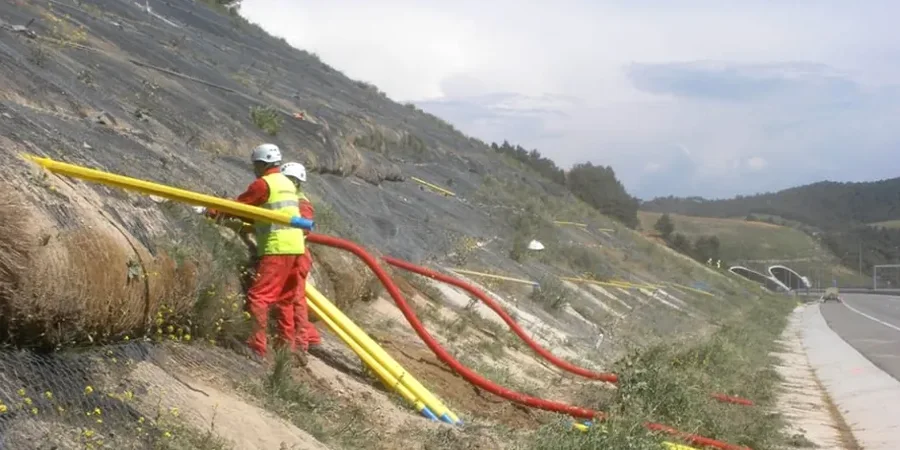
Illustrative image of Geotechnical drainage design in Cardiff
High plasticity clays in Cardiff can trap water for weeks after rainfall, so drainage design must account for transient pore pressures, not just static water tables.

Our service areas

Process overview

Our field team deploys multiple techniques to characterise subsurface flow in Cardiff. We use rising-head and falling-head tests in standpipes installed within rotary-cored boreholes, plus constant-head tests in granular horizons. For low-permeability clays common in the Llanishen and Rhiwbina areas, we run in-situ dissipation tests during CPT probing. The laboratory phase complements this: triaxial permeability tests (BS 1377-5) and flexible-wall tests on undisturbed samples quantify anisotropy. All results are interpreted using the Darcy-Weisbach relationship and non-linear flow models where gradients exceed critical values. The output is a 2D or 3D groundwater model that informs drain spacing, filter design, and discharge points. We cross-reference every design with settlement predictions to verify that dewatering won't induce unacceptable ground movement in Cardiff's cohesive soils.
Technical reference — Cardiff

Local context

In Cardiff, many engineers underestimate the speed at which the water table recovers after heavy rain. The city's combined sewer network and the high proportion of impermeable surfaces in the city centre mean that drainage systems must handle rapid infiltration pulses. Our designs always include a sensitivity analysis for worst-case groundwater levels, backed by continuous monitoring data from at least one full winter cycle. We also assess the risk of soil piping in the coarse granular layers of the Taff and Ely floodplains, specifying graded filters wherever the D₁₅/D₈₅ ratio exceeds 4. Ignoring these transient effects has led to flooded basements and failed retaining walls in Cardiff — a pattern our drainage design prevents.

Need a geotechnical assessment?

Reply within 24h.

Email: contact@geotechnical-engineering.biz

Relevant standards


BS 5930:2015 (Code of practice for ground investigations), BS EN 1997-1:2004 (Eurocode 7 – Geotechnical design), CIRIA C750 (Groundwater control: design and practice), Environment Agency (UK) – Groundwater Protection: Principles and Practice (GP3)

Typical values

ParameterTypical value
Soil permeability range (k)1x10⁻⁹ to 1x10⁻⁴ m/s
Typical groundwater depth1.5–5.0 m (Cardiff Bay vs. northern suburbs)
Design storm return period1 in 10 to 1 in 100 years (EA guidance)
Filter compatibility criteriaTerzaghi's filter rules (D₁₅/D₈₅ < 4)
Factor of safety for hydrostatic uplift1.3 (BS EN 1997-1:2004)

Q&A


Why is geotechnical drainage design critical in Cardiff?

Cardiff's high water table and variable soils (glacial till, Mercia Mudstone, alluvium) mean that uncontrolled groundwater can reduce bearing capacity, cause uplift, and trigger slope instability. Proper drainage design ensures long-term performance of foundations, basements, and retaining walls across the city.

What standards do you follow for drainage design in the UK?

We design strictly to BS 5930:2015 for ground investigation, BS EN 1997-1:2004 (Eurocode 7) for geotechnical design, and CIRIA C750 for groundwater control. All testing is performed under our UKAS-accredited quality system (ISO/IEC 17025).

How much does geotechnical drainage design cost in Cardiff?

A typical drainage design package for a residential project ranges from £580 to £1,840, depending on site size, number of boreholes, permeability tests, and modelling complexity. Commercial or infrastructure projects are quoted individually based on scope.

Can you retrofit drainage to an existing building in Cardiff?

Yes. We design retrofitted systems including perimeter trench drains, sump and pump arrangements, and horizontal directional drains for existing basements and retaining walls. Each design considers the specific groundwater regime and structural constraints of your Cardiff property.

Location and service area

We serve projects across Cardiff.

Location and service area