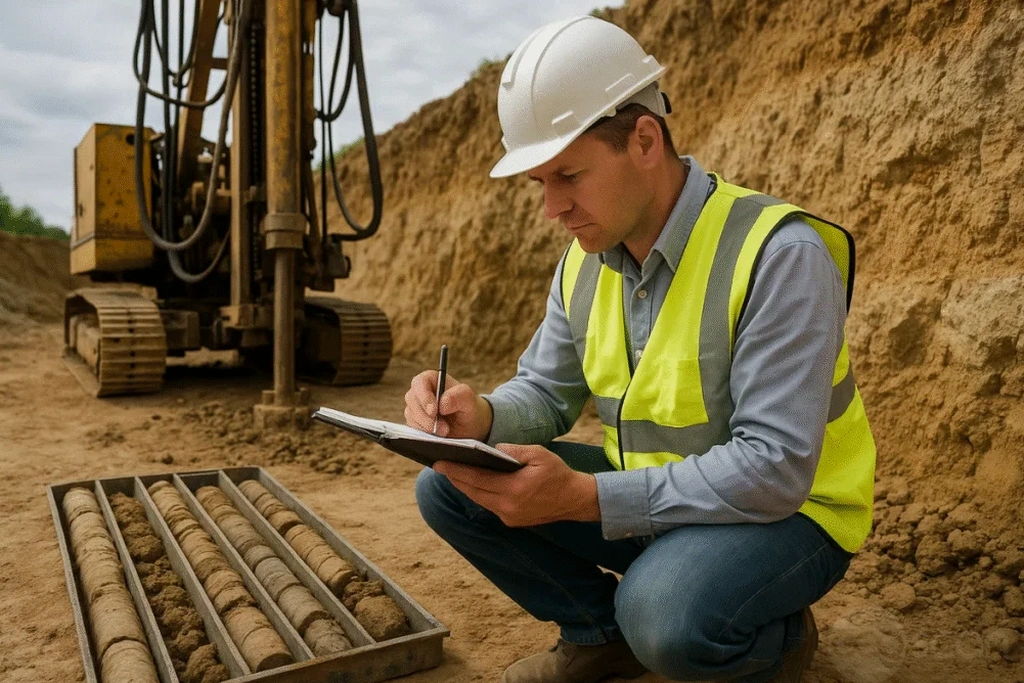
In the context of Cardiff's dynamic built environment, 'Improvement' refers to the essential ground engineering techniques employed to enhance the physical and mechanical properties of soil and rock, ensuring they can safely support construction and long-term land use. This category is foundational to urban regeneration, infrastructure resilience, and environmental stewardship. From the redevelopment of brownfield sites in the city centre to safeguarding the stability of transport corridors, ground improvement is not merely a construction phase but a critical risk-mitigation measure. The integration of specialised services like organic soil management is increasingly vital as Cardiff expands into its peri-urban fringes, where soft, compressible alluvial deposits are common.
Cardiff's underlying geology presents a complex and challenging profile that directly dictates the necessity for targeted ground improvement. The city is largely situated on a floodplain of the River Taff and River Ely, characterised by thick sequences of soft alluvial clays, silts, and peat layers, often interbedded with glacial till. These superficial deposits are notoriously weak and highly compressible, making them prone to significant settlement and instability. Beneath these Quaternary deposits lie the Mercia Mudstone Group and Carboniferous Limestone, which can present their own hazards, including solution features and variable bedrock topography. Such conditions mean that without rigorous interventions like jet grouting design, any major development risks structural failure, differential settlement, and long-term durability issues.
Any ground improvement scheme in Cardiff must strictly adhere to a robust framework of UK and Welsh standards. The primary regulatory reference is Eurocode 7 (BS EN 1997), specifically Part 1 on general rules and Part 2 on ground investigation, which mandates a design by calculation, prescriptive measures, or observational method. This is supported by the UK National Annex, which provides nationally determined parameters. Crucially, execution standards such as BS EN 14475 for the construction of special geotechnical works are legally enforceable. Furthermore, the Welsh Government's Planning Policy Wales (Edition 11) and Technical Advice Notes (TANs), particularly TAN 15 on development and flood risk, impose stringent requirements on ground stability and drainage in this low-lying city, directly influencing the design of geotechnical drainage design systems.
The application of these techniques spans a vast array of project typologies across Cardiff. Major infrastructure initiatives, such as the South Wales Metro and highway upgrades, require extensive ground treatment to stabilise embankments and bridge foundations over soft ground. High-density residential and commercial developments in areas like Cardiff Bay and the city centre rely on improvement to mitigate settlement and allow for shallow foundation solutions on reclaimed land. Equally, environmental remediation projects tackling legacy industrial contamination demand integrated approaches where soil improvement and management are combined. For any project involving excavation below the water table or interaction with the complex tidal regime of the Severn Estuary, a sophisticated geotechnical drainage design is non-negotiable to ensure stable and dry working conditions.
Ground improvement is a collective term for techniques that physically alter soil or rock mass to increase its strength, reduce its compressibility, or control its hydraulic conductivity. Unlike deep foundations that bypass weak soil, improvement treats the ground in-situ. Common methods include densification, consolidation, reinforcement, and chemical stabilisation, all aimed at making the natural ground a reliable engineering material for construction.
Cardiff's centre and Bay are predominantly underlain by thick, soft alluvial clays and peats from the Taff and Ely river systems, which are prone to significant long-term settlement. Without improvement, shallow foundations would experience unacceptable differential movement. Techniques are essential to stabilise this compressible ground, enabling safe high-rise construction and preventing damage to adjacent historic structures and infrastructure.
The design is governed by Eurocode 7 (BS EN 1997) and its UK National Annex, using a limit state design philosophy. Execution must conform to BS EN 14475. Site investigation, crucial for design, follows BS 5930. For projects in Wales, Planning Policy Wales and Technical Advice Notes, especially TAN 15 regarding flood risk and ground stability, add critical planning-level requirements that directly influence the geotechnical strategy.
The need is identified through a comprehensive ground investigation report, which will reveal hazards like soft clays, loose sands, or high groundwater. If this report predicts excessive total or differential settlement for your proposed structure, or indicates bearing capacity failure, a specialist improvement design is required. This is a standard recommendation from geotechnical consultants for any significant structure on Cardiff's floodplain deposits.